
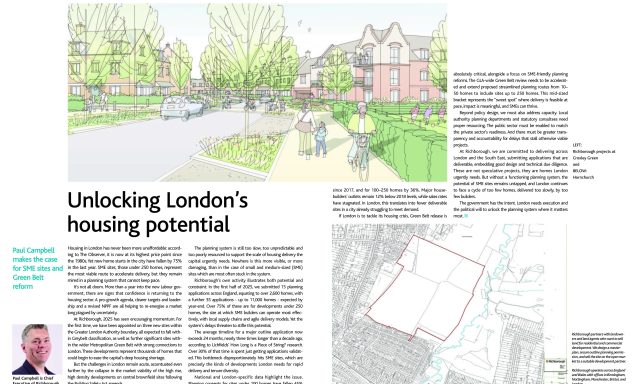
Our Chief Executive Paul Campbell has authored a feature in the October edition of Planning for London, setting out a clear case for Green Belt reform and SME-focused planning policy as the most practical route to tackling London’s housing crisis.
With housing affordability now at its worst level since the 1980s and new home starts down 75% in the past year, Paul argues that small and mid-sized sites, those under 250 homes, offer the fastest and most viable delivery model. Yet these schemes remain trapped in an under-resourced, inefficient planning system, where major outline applications take over 24 months to progress, with over 30% of that time lost at validation stage.
Momentum is nonetheless building. For the first time, Richborough has been appointed on three sites within the Greater London Authority boundary, all expected to be categorised as Greybelt, signalling a growing recognition that modest-scale, strategically located sites can unlock meaningful delivery. Alongside these, Richborough is progressing further significant sites within the wider Metropolitan Green Belt with strong connections to London — collectively representing thousands of homes that could begin to ease the capital’s deep housing shortage.
“These are not speculative projects,” Paul writes. “They are homes London urgently needs. But without a functioning planning system, the potential of SME sites remains untapped, and London continues to face a cycle of too few homes, delivered too slowly, by too few builders.”
Paul calls for three priorities:
- Accelerated Green Belt review across London
- Resourcing for local authority planning teams and statutory consultees
- Streamlined planning routes from 10–50 homes to up to 250
With clear national direction from government, Paul argues the real challenge is now execution. “London doesn’t lack intent,” he concludes. “It lacks operational delivery and the political will to unblock the system.”