
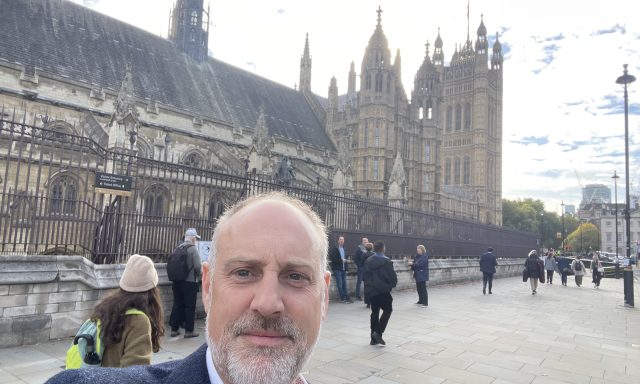
Stuart Nelmes, Richborough’s Group Technical Director, joined the parliamentary “Sponge Cities” session on 22nd October, hosted by Julia Buckley MP and the Chartered Institute of Water and Environmental Management (CIWEM).
With extensive experience in sustainable drainage systems (SuDS), planning and housing policy – and his work with the Home Builders Federation, Future Homes Hub and national housebuilders – Stuart was well placed to attend discussions on creating water-smart, resilient communities.
CIWEM invited Stuart following his role on the steering group set up to guide the CIWEM and Enabling Water Smart Communities project, which will shortly publish research on high-quality SuDS and a new cost-benefit tool to support SuDS planning and selection.
The session brought together industry, government and environmental experts. Julia Buckley MP, Lee Pitcher MP and Parliamentary Undersecretary of State for Water and Flooding, Emma Hardy MP, all highlighted the Government’s positive direction of travel in advancing SuDS, integrated flood management and nature-based solutions.
“Build Baby Build” was the message from Steve Reed (UK Housing Secretary) this week, to which CIWEM’s immediate reply was “Sponge Baby Sponge”. The discussion echoed this sentiment, the Government’s growth agenda and housing delivery targets must go hand-in-hand with environmental responsibility. Encouragingly, the Government appears ready to meet both challenges, exploring ways to incentivise and accelerate housing delivery where developers embrace high-quality SuDS and Water Smart initiatives.
There was clear recognition that these solutions add value and will help to meet national growth targets, as well as, importantly, delivering longer term cost savings and efficiency through reducing flood damage for downstream communities. CIWEM presented research showing that homes on developments featuring well-designed SuDS can be worth around £4,001 more, with wider societal benefits potentially worth billions over the next five years if delivered consistently across new developments.
The session reinforced the growing belief that high quality SuDS features can enhance communities beyond pure drainage function alone. Discussions underlined the placemaking benefits of SuDS from the biodiversity value of integrated blue-green infrastructure, through to the overall improved social, mental health and amenity values that come with high quality landscaped spaces. The need for more coordination with MHCLG, housebuilders and landscape architects was also emphasised, along with the key challenges that remain as barriers, including inconsistency around design and adoption standards and the longer-term responsibility and cost of maintenance.
CIWEM shared updates from its recent research ‘The Third Way’, exploring alternative methods to progressing the SuDS agenda without relying on the implementation of Schedule 3 of the Floods & Water Management Act and SuDS Approving Bodies (SABs), such as in Wales, that have experienced issues around adoption & maintenance costs and delays in decision making.
Stuart said: “I was honoured to be in attendance at this discussion. The need to address these issues grows year on year. For me, consistency is key. Coordination and alignment of national planning policy, clear minimum technical design standards, adoption and maintenance standards across all relevant Authorities are essential to give the housebuilding industry greater certainty and confidence to plan and invest. The new National SuDS Standards are a welcome step forward, but stop short of mandating minimum expectations and still allow for potentially too much variation in local application.
“As a chartered Water Environment Manager, I take a lot of pride in Richborough’s commitment to embed technical expertise in developments and ensure that they are sustainable from all aspects and in this regard, that water management is planned for at the earliest stages of site design.”