
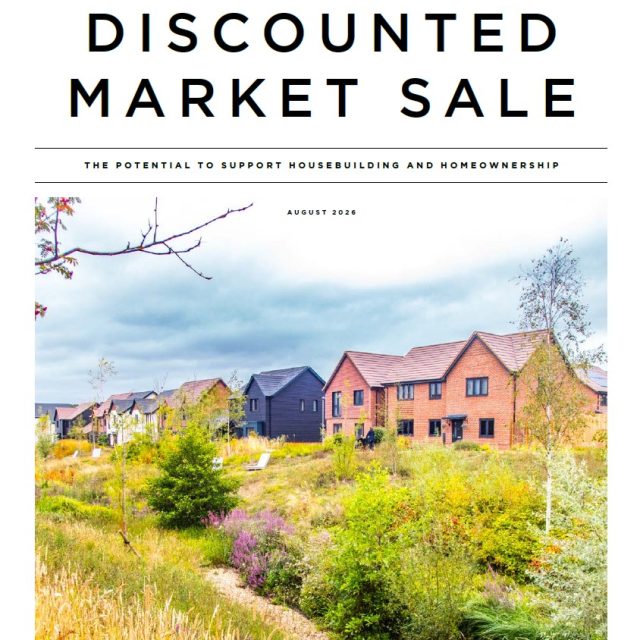
New Savills research sponsored by Richborough, the Land, Planning and Development Federation (LPDF) and Barratt Redrow examines how greater use of Discounted Market Sale could help unlock stalled housing development and enable more families to access home ownership.
The research suggests greater use of Discounted Market Sale (DMS) through Section 106 agreements could help unlock stalled housing developments while putting home ownership within reach of hundreds of thousands more families.
The report, called Discounted Market Sale: The Potential to Support Housebuilding and Homeownership, comes as constrained Housing Association capacity is reducing demand for some Section 106 affordable housing packages, creating a barrier to getting much-needed homes built.
What is Discounted Market Sale?
DMS enables eligible buyers to purchase a home at a discount of at least 20% below market value, with that discount retained for future eligible purchasers. First Homes are a type of DMS with a minimum 30% discount.
Crucially, DMS does not require the involvement of a Registered Provider (RP), meaning it could provide an alternative route for delivering affordable home ownership where an RP purchaser cannot be secured.
While DMS is tried and tested, it has remained a relatively small part of housing delivery, with DMS and First Homes averaging just 1,760 homes a year over the ten years to 2024/25.
Could DMS help unlock stalled housing development?
The research highlights the impact that constrained RP demand for Section 106 affordable housing is having on housing delivery.
Home Builders Federation evidence cited by Savills identified 8,500 consented Section 106 affordable homes without Housing Association purchasers, either under construction or due to commence within 12 months. HBF members also estimated that more than 700 sites had been delayed or stalled over the previous three years because developers had been unable to sell Section 106 packages to RP’s.
Savills also recommends use of cascade mechanisms within Section 106 agreements as a default position, allowing DMS or financial contributions in lieu to be considered where an RP purchaser cannot be secured.
Conventional affordable housing tenures may remain the preferred option depending on local housing need and circumstances. But where RP demand is muted due to financial capacity issues, the research argues greater flexibility could help unlock development while continuing to deliver affordable home ownership.
This could become increasingly important as Government seeks to rapidly increase housebuilding. Savills argues that more private housing delivery will generate a greater amount of Section 106 affordable housing than there is RP capacity to acquire them. There is a risk of trapped permissions if the use of DMS isn’t embraced and this impacts SME’s in a more pronounced way because without flexibility in the S106 it limits the ability to secure development finance.
Putting home ownership within reach
The potential identified by Savills extends beyond unlocking development.
Its analysis estimates that 530,000 families currently living in the private rented sector could afford a new three-bedroom home through DMS at a 30% discount, assuming they have a 5% deposit.
That’s equivalent to 34% of all families with dependent children in the private rented sector.
At a 20% discount, around 350,000 families could potentially afford to buy.
The research therefore suggests DMS could help address two challenges: supporting housing delivery where RP demand is constrained and giving more families an affordable route from renting into home ownership.
Why this matters to Richborough
For us as a land promoter, securing planning permission is only part of the journey.
Unlocking the true potential of Britain’s land means creating high-quality, deliverable schemes that can become the homes and places communities need.
That means considering deliverability from the earliest stages of a project and being pragmatic about the barriers that can prevent otherwise suitable and consented sites from progressing.

Paul Campbell, Chief Executive at Richborough, said: “If we’re serious about increasing housing delivery, we need practical solutions to the barriers preventing otherwise deliverable sites from moving forward.
“This research shows how greater flexibility around DMS could help unlock development while giving many more families a route from renting to owning.”
Richborough was pleased to sponsor this important research alongside LPDF and Barratt Redrow, and to contribute our experience as a land promoter to Savills’ work.
Read the research here: Discounted Market Sale: The Potential to Support Housebuilding and Homeownership